
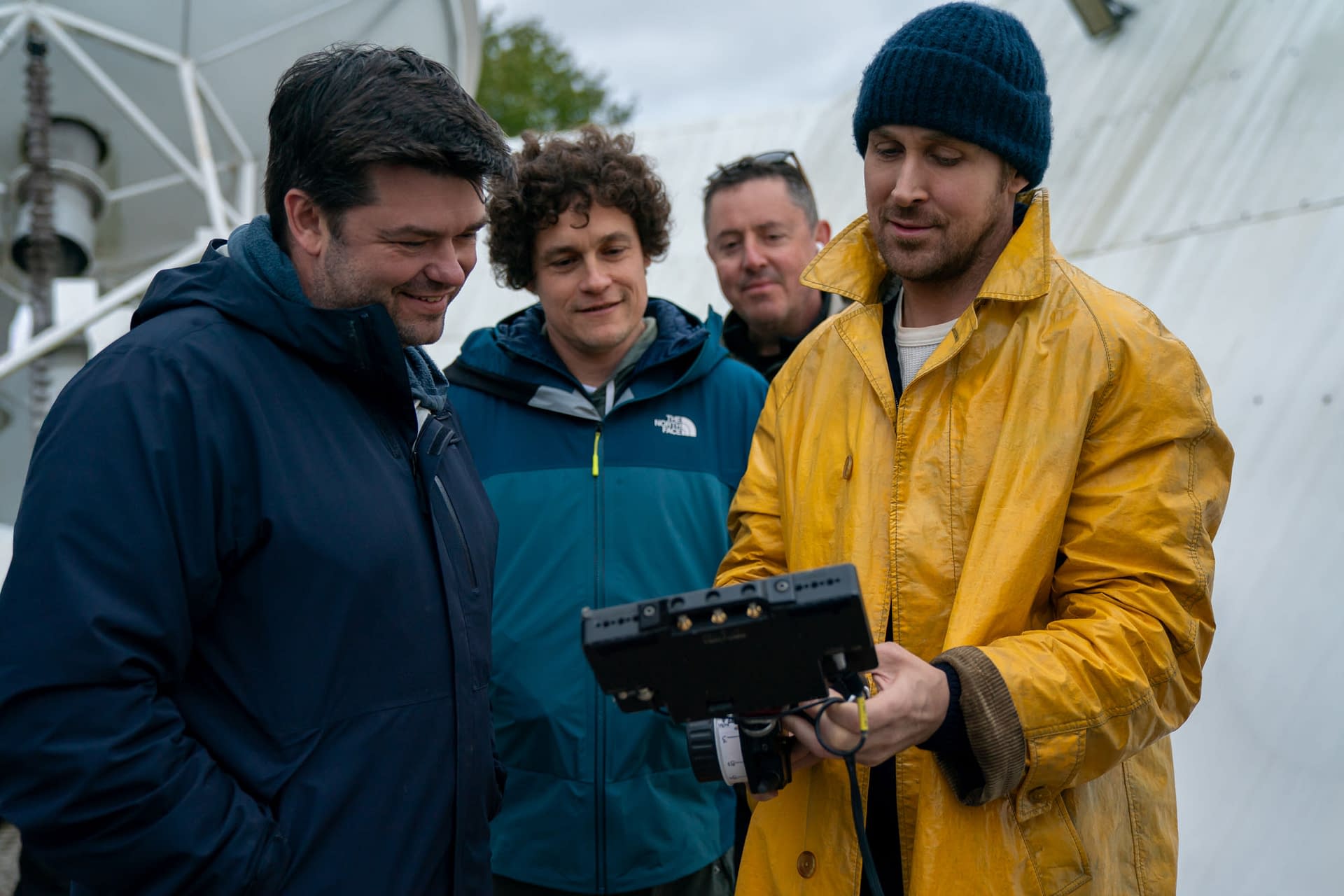
Phil Lord and Christopher Miller are bringing Andy Weir's Project Hail Mary to the big screen with a refreshingly old-school approach: they built it for real. From a fully constructed spaceship set to a physically designed alien, here's how practical effects are shaping the year's most anticipated sci-fi film.
In an era where CGI dominates the blockbuster landscape, directors Phil Lord and Christopher Miller are taking a different approach with their adaptation of Andy Weir's beloved novel Project Hail Mary. The filmmaking duo, known for The Lego Movie, 21 Jump Street, and Spider-Man: Into the Spider-Verse, have gone decidedly old-school: they built it for real .
In a new featurette and interviews surrounding the film's upcoming release, Lord and Miller have been showcasing the extensive practical effects used throughout production—a decision they believe will set the film apart from other sci-fi epics .
A Spaceship You Can Touch
The centerpiece of their practical approach is the spaceship itself. Rather than relying on green screens and digital environments, the production team constructed a fully functional, full-scale set of the interstellar vessel where much of the story takes place .
"We wanted the actors to feel like they were actually in space, actually on this ship," Miller explained. "When you're standing on a set that's really there, that you can reach out and touch, it changes everything about your performance. It's not imaginary anymore" .
According to the directors, no green or blue screens were used during filming for scenes set aboard the ship. Every surface, every button, every piece of equipment was physically present on set . This commitment to practicality extends to the film's zero-gravity sequences, which were achieved through a combination of wire work, gimbals, and practical rigging rather than digital weightlessness .
Bringing Rocky to Life
One of the most anticipated elements of Project Hail Mary is Rocky, the alien creature who becomes the protagonist's unlikely companion. In the novel, Rocky is a spider-like being from a completely different biological lineage—a challenge for any adaptation .
Lord and Miller opted for a hybrid approach. Rocky was designed physically, with a practical puppet and animatronic created for on-set interaction. This allowed star Ryan Gosling (playing amnesiac scientist Ryland Grace) to perform opposite a tangible presence rather than a tennis ball on a stick .
"We built Rocky," Lord confirmed. "There's a physical thing there. Then we augmented with CG to bring out the details and the movement, but the foundation is practical. Ryan was acting against something real, and you can see that in the performances" .
The directors emphasized that the practical foundation would make the CG enhancement feel more grounded and believable .
The Andy Weir Touch
Project Hail Mary follows a lone astronaut who wakes up on a spaceship with no memory of who he is or how he got there. As he pieces together his mission, he discovers he's on a desperate journey to save humanity—and that he's not alone .
Andy Weir's previous novel, The Martian, was adapted into a critical and commercial success by Ridley Scott in 2015. That film also emphasized practical effects and scientific accuracy, setting a high bar for this adaptation .
Lord and Miller have worked closely with Weir throughout production, ensuring the film honors the book's meticulous science while translating its emotional core to the screen .
Early Buzz and Box Office Expectations
While the film doesn't open until later this month, early industry screenings have generated strong word of mouth. Sources suggest that MGM and Amazon Studios (which is distributing the film) are confident in the project's commercial prospects, with some analysts predicting a $40-50 million opening weekend .
The combination of Lord and Miller's proven track record, Gosling's star power, and the beloved source material has positioned Project Hail Mary as one of 2026's most anticipated releases. The directors' commitment to practical effects—and the resulting visual authenticity—could be the element that elevates it from successful adaptation to genuine phenomenon .
A Return to Practical Sci-Fi
Lord and Miller join a growing list of filmmakers advocating for practical effects in science fiction. Denis Villeneuve's Dune films, Christopher Nolan's Interstellar, and Ridley Scott's The Martian all emphasized real environments and minimal CGI wherever possible .
"There's something about a real spaceship, real light, real textures that your eye just accepts as truth," Lord reflected. "CGI is an incredible tool, but it should serve the story, not replace the world. We wanted to build a world our actors could live in—and our audience could believe in" .

No comments yet
Be the first to share your thoughts on this article!